
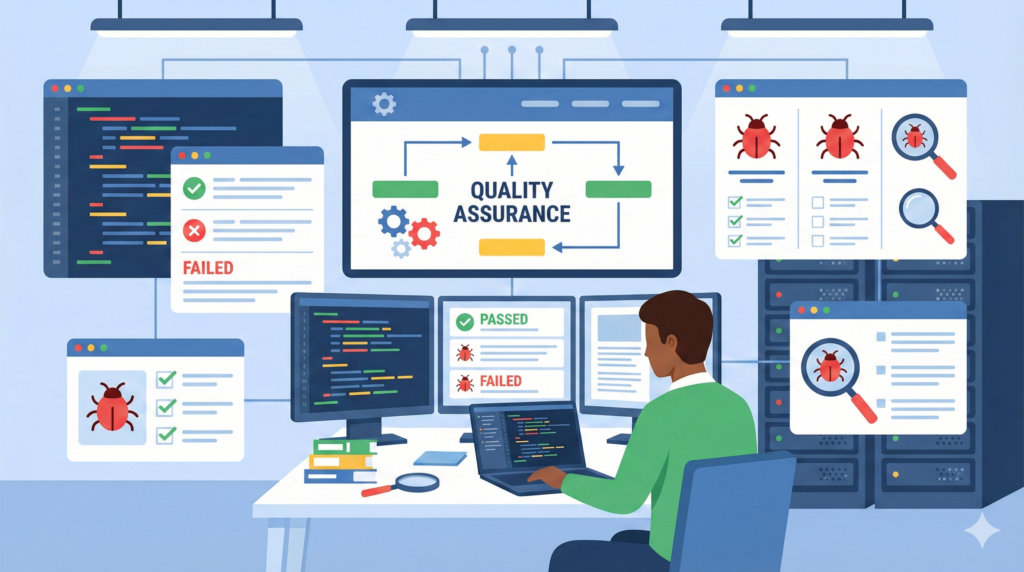
Quality Assurance (QA) Engineers are an integral part of the software development process. Their role focuses on ensuring the quality, stability, and reliability of digital products before they are released to the public. QA Engineers conduct systematic testing to verify that every feature meets the required technical and functional standards.
Within the software development workflow, QA Engineers are responsible for designing, executing, and evaluating testing processes. They collaborate closely with development teams to identify bugs, provide insights for quality improvements, and ensure the product is ready for launch. As digital transformation continues to accelerate in Indonesia, the demand for QA Engineers has steadily increased, especially in industries that prioritize system performance and security.

Why Is the QA Engineer Role Becoming More Critical?
The role of QA Engineers is increasingly important because software quality directly affects user trust and business continuity. The following key responsibilities demonstrate the complexity of the QA Engineer role:
- Planning and Designing Testing Strategies
QA Engineers develop comprehensive testing strategies, including selecting the appropriate methods and tools to ensure all software components can be thoroughly tested. - Developing Test Cases
QA Engineers are responsible for creating and managing test cases for various scenarios. These test cases are essential for evaluating software functionality and performance under different conditions. - Performing Manual and Automated Testing
QA Engineers develop and manage test cases used to verify software functionality and performance through manual and automated testing methods. - Bug Identification and Reporting
During testing, QA Engineers identify, track, and report bugs or issues so they can be resolved promptly. - Collaboration with Development Teams
QA Engineers work closely with developers to ensure bugs are fixed effectively, helping accelerate the development process and improve product quality. - Test Result Analysis
QA Engineers analyze testing outcomes and provide recommendations to enhance product quality, including identifying areas that may pose potential issues. - Developing Testing Documentation
QA Engineers prepare and maintain testing documentation such as test plans, test cases, and test reports, which serve as essential references for future testing processes.
Required Skills
Technical Skills:
- Manual Testing: Identifying bugs and issues without automation tools.
- Automated Testing: Using tools such as Selenium or Appium to automate testing processes.
- API Testing: Ensuring that communication between applications functions correctly.
- Performance Testing: Measuring application performance under specific loads.
- Security Testing: Ensuring the application is protected from potential threats.
Non-Technical Skills:
- Analytical thinking to solve complex problems
- Strong verbal and written communication
- High attention to detail
- Good time management
- Creativity in designing comprehensive test scenarios
- Flexibility and adaptability in dynamic development environments
Common Tools Used by QA Engineers
- Katalon Studio: An automation tool for web and mobile testing, supporting programming languages such as Java and Groovy.
- Selenium: A popular automation tool for cross-browser web testing, supporting multiple languages including Java, Python, and C#.
- Postman: A widely used API testing tool that enables QA Engineers to send HTTP requests and evaluate responses through an intuitive interface.
- Appium: An automation tool for mobile application testing across iOS and Android, supporting languages such as Java, Python, and Ruby. diterima.
- Appium: Tools otomasi untuk pengujian aplikasi mobile di platform iOS dan Android. Alat ini menggunakan bahasa pemrograman seperti Java, Python, dan Ruby.
Salary Range
QA Engineer salaries in Indonesia vary widely. Based on data from multiple sources, here are the estimated monthly salary ranges (in Indonesian Rupiah):
- Junior QA Engineer (0–3 years of experience): Rp 4 – 8 million
- Mid-level QA Engineer (3–5 years of experience): Rp 8 – 15 million
- Senior QA Engineer (5+ years of experience): Rp 17 – 35 million
- QA Lead/Manager: Rp 26 – 48 million
These ranges may vary depending on the industry, company location, as well as the candidate’s skill level and experience.
QA Engineer Recruitment Services by Geekhunter
Finding the right QA Engineer or the ideal career opportunity is not always easy. Whether you are a company aiming to enhance your digital product quality or a QA Engineer seeking your next career move, Geekhunter is here to make the process simpler and more efficient.
With a database of thousands of verified QA Engineers, companies can access highly qualified talent capable of ensuring stable, secure, and ready-to-launch products. At the same time, QA Engineers can connect to job opportunities that align with their skills, experience, and career goals.
Build your best QA team at geekhunter.co/recruitnow
Or discover career opportunities as a QA Engineer at jobs.geekhunter.co