
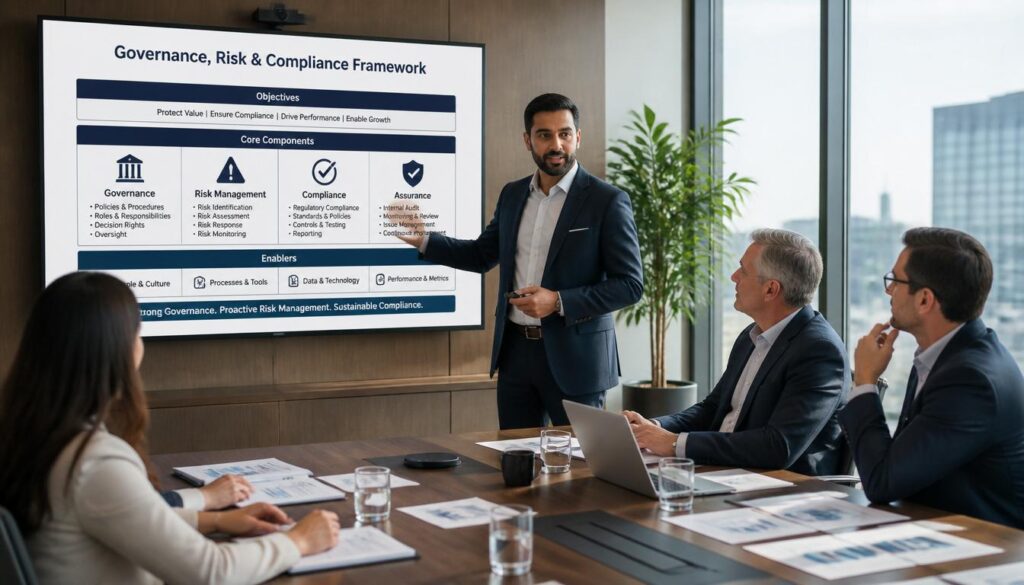
Digital transformation has fundamentally changed how organizations operate. Cloud computing, digital banking, fintech, artificial intelligence, and increasingly complex third-party ecosystems have created new opportunities for business growth. At the same time, they have also introduced new challenges, ranging from operational risks and cyber threats to evolving regulations and stricter audit requirements.
Many organizations have invested heavily in cybersecurity technologies and security solutions. However, without strong governance, structured risk management, and effective compliance practices, those investments alone may not be enough to support long-term business objectives.
This is why Governance, Risk, and Compliance (GRC) Managers are becoming increasingly important. They help organizations manage risk, ensure regulatory compliance, and establish governance frameworks that enable businesses to grow securely and sustainably.
What Is a GRC Manager?
A GRC Manager is a professional responsible for managing governance, risk, and compliance to ensure that business strategy, security, and regulatory requirements remain aligned.
The role covers policy development, risk assessments, audit coordination, third-party risk management, regulatory compliance, and advising leadership on business decisions based on organizational risk.
Unlike roles that primarily focus on implementing security technologies, a GRC Manager takes an organization-wide perspective. Their objective is not only to ensure regulatory compliance but also to help businesses proactively manage risks without slowing innovation or business growth.
GRC Manager vs Compliance Manager vs Risk Manager
These three roles are often used interchangeably because they all deal with organizational risk. However, each serves a different purpose.
- GRC Managers integrate governance, risk management, and compliance to align security initiatives, regulatory obligations, and business objectives.
- Compliance Managers focus on ensuring the organization complies with applicable regulations, industry standards, and internal policies.
- Risk Managers identify, assess, and manage risks that may affect business operations or organizational objectives, including financial, operational, and strategic risks.
In practice, GRC Managers collaborate closely with compliance, risk management, legal, audit, cybersecurity, and executive leadership teams to ensure governance and risk management are managed as an integrated business function.
Why Are GRC Managers Becoming More Important?
The risks organizations face today extend far beyond cybersecurity. Businesses must also navigate evolving regulations, third-party risks, personal data protection requirements, and increasing expectations for corporate governance from regulators, customers, and business partners.
Several factors are driving the growing demand for GRC Managers:
- Rapid cloud adoption and digital transformation
- Increasingly stringent cybersecurity and data protection regulations
- The need to comply with standards such as ISO 27001, PCI DSS, and other governance frameworks
- Growing risks associated with vendors and third-party ecosystems
- Higher demand for both internal and external audits
- Greater organizational focus on enterprise risk management and business resilience
In Indonesia, demand for GRC Managers continues to grow, particularly across banking, fintech, telecommunications, healthcare, energy, and enterprise organizations that must balance regulatory compliance with operational resilience.
Who Hires GRC Managers?
Demand for GRC Managers extends well beyond cybersecurity-focused organizations. Today, companies across many industries are looking for professionals who can manage governance, enterprise risk, and regulatory compliance in a structured and scalable way.
Industries actively hiring GRC Managers in Indonesia include:
- Banking and Digital Banking
- Fintech and Payment Companies
- Insurance
- Telecommunications
- Healthcare and Life Sciences
- Risk & Cybersecurity Consulting Firms
- Technology and SaaS Companies
- Enterprise Organizations (Manufacturing, Energy, FMCG)
- Government Institutions and State-Owned Enterprises
As regulatory requirements continue to evolve and business environments become more complex, many organizations are also establishing dedicated GRC functions to strengthen governance, improve compliance, and proactively manage enterprise risk.
Roles and Responsibilities of a GRC Manager
A GRC Manager ensures that governance, risk, and compliance are not treated as separate functions but become an integral part of the organization’s business strategy.
Daily Responsibilities
- Risk Assessment: Identify, analyze, and evaluate risks that may impact business operations and organizational objectives.
- Policy & Governance Management: Develop, maintain, and oversee the implementation of corporate policies, governance frameworks, and security standards.
- Compliance Monitoring: Ensure the organization complies with applicable regulations, industry standards, and internal policies.
- Audit Coordination: Coordinate internal and external audits while managing remediation efforts for audit findings.
- Third-party Risk Management: Assess risks associated with vendors, business partners, outsourcing providers, and other third parties.
- Executive Reporting: Prepare reports on organizational risk, governance, and compliance for senior management and key stakeholders.
Strategic Responsibilities
- Governance Framework Development: Design governance frameworks that support both business strategy and information security objectives.
- Enterprise Risk Management: Develop an integrated approach to managing risks across the organization.
- Regulatory Readiness: Prepare the organization for regulatory changes, compliance assessments, and external audits.
- Business Continuity & Resilience: Support business continuity planning and operational resilience initiatives to minimize the impact of potential disruptions.
- Cross-functional Leadership: Collaborate with legal, audit, IT, cybersecurity, HR, and executive leadership teams to ensure governance and risk management practices are consistently implemented across the organization.
Skills That Build a Strong GRC Manager
Becoming a successful GRC Manager requires a combination of expertise in information security, risk management, regulatory compliance, and the ability to communicate effectively with stakeholders across the organization.
Unlike many cybersecurity roles that focus primarily on technical implementation, GRC Managers must translate complex risks into business recommendations that executives and business leaders can understand and act upon.
Hard Skills
- Governance Framework: Understand governance frameworks such as COBIT, the NIST Cybersecurity Framework, and ISO/IEC 27001 to help organizations establish effective governance practices.
- Risk Assessment & Risk Management: Identify, assess, prioritize, and manage risks that could affect business operations, regulatory compliance, and organizational objectives.
- Compliance Management: Understand applicable regulations, industry standards, and audit requirements while ensuring compliance is maintained across the organization.
- Information Security Governance: Develop security policies, governance processes, and risk-based decision-making practices that align with business objectives.
- Third-party Risk Management: Assess risks associated with vendors, outsourcing partners, cloud providers, and other third-party relationships.
- Business Continuity & Resilience: Understand business continuity, disaster recovery, and operational resilience to help organizations prepare for and recover from disruptions.
Soft Skills
- Strategic Thinking: Understand how governance, risk, compliance, and cybersecurity support long-term business goals.
- Stakeholder Management: Build effective relationships with executives, regulators, auditors, business leaders, and technology teams.
- Communication: Translate complex regulatory requirements and business risks into clear, actionable recommendations.
- Leadership: Lead governance, risk, and compliance initiatives involving multiple business and technology teams.
- Decision Making: Prioritize initiatives and make balanced decisions based on business impact and organizational risk.
Ultimately, GRC Managers do more than ensure regulatory compliance—they help organizations make informed business decisions through structured governance and proactive risk management.
Common Frameworks and Tools Used by GRC Managers
GRC activities are supported by a combination of governance frameworks, risk management methodologies, and technology platforms that help organizations manage governance, audits, compliance, and enterprise risk more effectively.
- Governance & Compliance Framework: ISO/IEC 27001, COBIT, NIST Cybersecurity Framework, COSO ERM
- Risk Management Framework: ISO 31000, FAIR, Enterprise Risk Management (ERM)
- GRC Platforms: ServiceNow GRC, RSA Archer, MetricStream, OneTrust
- Audit & Documentation: Jira, Confluence, Microsoft Excel, Microsoft Power BI
While these frameworks and platforms help standardize governance and compliance processes, a GRC Manager’s greatest value lies in their ability to translate business risks into practical governance strategies that support organizational growth.
GRC Manager Salary Outlook in Indonesia
GRC Manager is typically a management-level position, making it one of the higher-paying career paths within cybersecurity, governance, and enterprise risk management. Demand for experienced GRC professionals continues to increase as organizations face more complex regulations, audit requirements, and enterprise risk challenges.
Based on Geekhunter’s experience recruiting cybersecurity, governance, and technology leaders across banking, fintech, telecommunications, consulting, and enterprise organizations, combined with market benchmarks and industry data, the estimated monthly salary range for GRC Managers in Indonesia is:
- Junior GRC Manager (5–7 years of experience): ~IDR 25,000,000 – IDR 35,000,000 per month
- Mid-Level GRC Manager (7–10 years of experience): ~IDR 35,000,000 – IDR 50,000,000 per month
- Senior GRC Manager (10+ years of experience): ~IDR 50,000,000 – IDR 65,000,000+ per month
- Head of GRC / VP Risk & Compliance: ~IDR 65,000,000 – IDR 81,000,000+ per month
Actual compensation varies depending on the industry, regulatory complexity, organizational scale, leadership responsibilities, and professional certifications.
Professionals with proven experience leading ISO 27001 implementation, enterprise risk management initiatives, regulatory audits, or governance transformation projects within large organizations typically command salaries above the market average due to the limited supply of experienced GRC leaders.
How to Build a Career as a GRC Manager
Most GRC Managers do not begin their careers in management positions. Instead, they typically develop their expertise through roles in audit, compliance, information security, or enterprise risk management before progressing into leadership positions.
Common Professional Backgrounds
- GRC Analyst
- Information Security Analyst
- IT Auditor
- Internal Auditor
- Risk Management Analyst
- Security Consultant
- Compliance Officer
Although career paths vary between organizations, a typical progression looks like this:
GRC Analyst → Senior GRC Analyst → GRC Manager → Head of GRC → Director / VP of Risk & Compliance
In practice, most GRC Managers have approximately 6–10 years of experience in governance, risk management, compliance, audit, or information security before taking responsibility for enterprise-wide GRC functions.
What differentiates a GRC Manager from an individual contributor is not just years of experience, but the ability to establish governance frameworks, lead cross-functional initiatives, manage executive stakeholders, and align risk management with broader business strategy.
What to Build
- Strong knowledge of governance, risk management, and compliance principles
- Experience conducting risk assessments and managing audits
- The ability to develop organizational policies and governance frameworks
- Familiarity with industry regulations and international standards
- Experience working with regulators, auditors, and executive leadership
Recommended Certifications
- CRISC (Certified in Risk and Information Systems Control)
- CISA (Certified Information Systems Auditor)
- CISM (Certified Information Security Manager)
- ISO/IEC 27001 Lead Implementer
- ISO/IEC 27001 Lead Auditor
- CGEIT (Certified in the Governance of Enterprise IT)
Professional certifications help strengthen credibility. However, employers generally place greater value on candidates who have successfully led audits, managed enterprise risks, and implemented governance frameworks in complex business environments.
The Future Outlook for GRC Managers
As regulations become more complex, digital risks continue to evolve, and organizations increasingly rely on cloud services, artificial intelligence, and third-party ecosystems, the role of the GRC Manager is expected to become even more strategic in the years ahead.
Traditionally, GRC functions were primarily associated with audits and regulatory compliance. Today, however, organizations increasingly view GRC as a business function that enables proactive risk management while supporting long-term growth and operational resilience.
At the same time, the rapid adoption of AI is introducing new governance challenges related to transparency, security, data privacy, and the responsible use of AI. As organizations begin establishing AI governance frameworks, GRC Managers are playing a growing role in developing policies, assessing AI-related risks, and ensuring AI initiatives align with regulatory requirements, ethical principles, and business objectives.
For professionals who combine business acumen, governance expertise, and strong stakeholder management skills, GRC offers one of the most promising long-term leadership career paths in today’s technology and cybersecurity landscape.
Why Companies Are Investing More in GRC Talent
Organizations today are expected to do more than simply comply with regulations. They must also demonstrate that risks are being proactively identified, managed, and aligned with business objectives.
GRC Managers help organizations strengthen governance, improve regulatory compliance, reduce operational risks, and support risk-based decision-making. This enables businesses to build trust with customers, regulators, investors, and business partners while creating a stronger foundation for sustainable growth.
As digital transformation accelerates, regulations become increasingly complex, AI adoption continues to grow, and organizations rely more heavily on cloud services and third-party ecosystems, managing risk has become significantly more challenging. As a result, GRC is no longer viewed as simply a compliance function—it has evolved into a strategic business function that helps organizations manage risk proactively, meet regulatory expectations, and support sustainable business growth. This is why demand for experienced GRC Managers in Indonesia is expected to continue rising across industries.
Hire the Best GRC Managers in Indonesia with Geekhunter
Experienced GRC Managers who combine governance expertise, enterprise risk management, regulatory compliance, and business leadership remain in limited supply across Indonesia.
Many professionals have strong backgrounds in audit, compliance, or information security. However, fewer candidates can translate organizational risks into business strategies, lead cross-functional governance initiatives, and build governance frameworks that support long-term business growth.
Geekhunter helps organizations find GRC Managers who not only understand governance and regulatory requirements but can also strengthen risk management practices, improve compliance, and support sustainable business growth.
Looking for a GRC Manager for your company?
👉 Hire a GRC Manager now: https://geekhunter.co/recruit-now/
Interested in building a career as a GRC Manager?
👉 Explore the latest GRC Manager opportunities: https://geekhunter.co/careers