
Have you ever wondered how imported smartphones from China or the U.S. are available on Indonesian marketplaces just days after their global release? Or how your favorite coffee shop continues to serve imported coffee beans without running out of stock?
This doesn’t happen by chance. Behind smooth distribution lies a complex and well-structured supply chain system, and one of the most critical roles in this system is the Supply Chain Analyst.
In Indonesia, almost every industry depends heavily on supply chain operations — from FMCG, manufacturing, retail, and e-commerce to pharmaceuticals and automotive. As supply chain complexity grows, supply chain jobs in Indonesia are becoming increasingly strategic and data-driven.
The challenge is even greater compared to many countries because Indonesia consists of thousands of islands. Products move from international suppliers, through major ports like Tanjung Priok, to regional distribution warehouses, and finally to end customers.
Each stage requires precise, efficient, and data-driven planning — making the role of a Supply Chain Analyst in Indonesia more crucial than ever.
What Is a Supply Chain Analyst?
A Supply Chain Analyst is a professional responsible for planning, analyzing, and monitoring the entire supply chain process to ensure products reach customers on time while keeping costs optimized.
The role goes beyond data processing. Analysts must maintain a balance between market demand, inventory availability, production capacity, and logistics costs. This means they need to see the big picture of operations while understanding technical details at every stage of the supply chain.
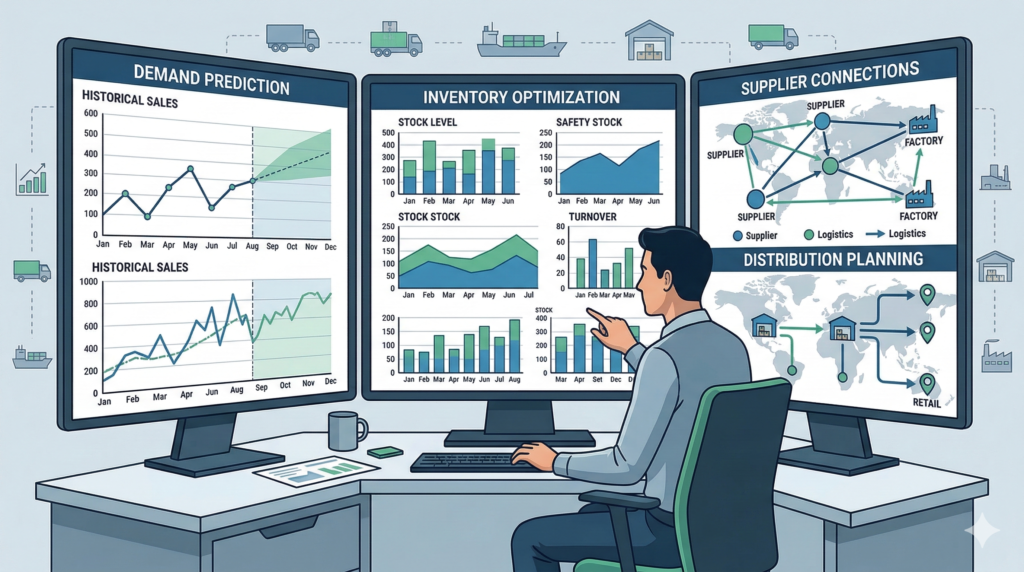
In Indonesia, typical responsibilities include inventory analysis, demand forecasting, distribution planning, vendor evaluation, and logistics cost optimization. Analysts often act as liaisons between the company and suppliers, including those from China, Vietnam, and other Asian countries.
Due to the direct impact on profit margins, the Supply Chain Analyst role is no longer considered merely operational support. In many Indonesian companies, it has evolved into a strategic role involved in long-term business decision-making.
Key Responsibilities of Supply Chain Analysts
- Demand Analysis & Forecast Accuracy: Evaluating historical sales data, seasonal patterns, and demand fluctuations to measure forecast accuracy and prevent overstock or stockouts.
- Inventory Optimization: Calculating safety stock, reorder points, and service level targets to maintain a balance between availability and storage costs.
- MRP & Planning Parameter Analysis: Reviewing Material Requirements Planning (MRP) results, analyzing exception messages, and adjusting ERP parameters like lead time, lot size, and safety stock.
- Supply Chain KPI Monitoring: Tracking key indicators such as OTIF (On Time In Full), inventory turnover, fill rate, lead time variability, and total supply chain cost to support managerial decisions.
- Cost & Efficiency Modeling: Building simulations to evaluate scenarios such as new warehouse additions, route changes, inventory pooling strategies, or supplier adjustments.
- Strategic Insights: Delivering data-driven reports and recommendations to management to improve operational efficiency and reduce supply disruption risks.
Specializations of Supply Chain Analysts
Depending on the organization, a Supply Chain Analyst may focus on:
- Production Planning: Planning production based on forecasts and factory capacity.
- Inventory Management: Maintaining stock balance while optimizing storage costs.
- Raw Material Sourcing: Evaluating and selecting suppliers.
- Demand Planning: Predicting market demand using historical data and trends.
- Supply Chain Network Design: Designing the most efficient distribution structure.
- Distribution Planning: Managing intercity and inter-island delivery strategies.
In large companies, these functions are usually separate. In mid-sized companies, a single analyst may handle multiple areas.
Why Is Demand for Supply Chain Analysts Increasing in Indonesia?
The demand for Supply Chain Analysts in Indonesia is rising significantly due to several business pressures and market shifts:
- Rapid e-commerce growth is increasing order volumes, fulfillment complexity, and last-mile delivery challenges.
- Logistics cost volatility (fuel prices, import costs, global supply disruptions) forces companies to optimize procurement and distribution strategies.
- Margin pressure across manufacturing, FMCG, and retail sectors requires tighter cost control and better inventory planning.
- Data-driven decision making is becoming essential as companies digitize operations and implement ERP or supply chain management systems.
In the Indonesian hiring market, Supply Chain Analyst positions are among the most competitive mid-level roles. Many companies report difficulty finding candidates who not only understand ERP systems but can also interpret data strategically and communicate cross-functionally.
A skilled Supply Chain Analyst can deliver measurable outcomes, such as:
- Improved forecast accuracy → Lower inventory costs
When demand forecasting improves, companies reduce excess stock and avoid overproduction. This directly lowers storage costs and write-offs. - Optimized inventory turnover → Healthier working capital
Better planning ensures faster stock movement, reducing cash tied up in unsold inventory and improving overall cash flow.
In competitive industries, even a 5–10% improvement in forecast accuracy can translate into billions of rupiah in cost savings annually — making this role strategically important, not just operational.
Essential Skills for Supply Chain Analysts
Hard Skills:
- ERP Systems (SAP/Oracle): Understanding inventory, procurement, distribution, and MRP modules.
- Data Analysis & Reporting: Converting operational data into actionable insights.
- Demand Forecasting: Using statistical methods to predict demand and minimize overstock or stockout.
- Inventory Optimization: Calculating safety stock, reorder points, and analyzing demand and lead time variability.
- Transportation Cost Analysis: Evaluating distribution costs, route efficiency, and logistics savings opportunities.
- Business Intelligence Tools: Using dashboards and data visualization for data-driven decision-making.
Soft Skills:
- Communication: Coordinating across departments and negotiating with suppliers, including international partners.
- Critical Thinking & Problem Solving: Addressing challenges such as port delays, rising logistics costs, and currency fluctuations.
- Negotiation: Securing favorable pricing and service levels from vendors.
- Stakeholder Management: Managing interests across multiple teams effectively.
- Time Management: Handling dynamic environments with simultaneous deadlines.
Common Tools Used by Supply Chain Analysts
- Demand Planning Systems (APS): SAP IBP, Oracle Demand Management, Blue Yonder for statistical forecasting like moving averages or exponential smoothing.
- Inventory Optimization Engines: SAP IBP Inventory, E2open, ToolsGroup for calculating safety stock based on service level probability and demand variability.
- Supply Network Design / Modeling Software: Llamasoft Supply Chain Guru (Coupa), AnyLogistix for simulating warehouse locations, network footprint, and cost-to-serve modeling (usually for large or multinational companies).
- MRP / DRP Modules (ERP): SAP/Oracle MRP & DRP for running planning cycles, evaluating exceptions, and adjusting parameters like lead time, lot size, and safety stock.
- Business Intelligence Platforms & Excel: Power BI, Tableau, Qlik Sense, or internal ERP dashboards for creating operational dashboards and reports to support management decision-making.
In mid-sized or local companies, not all high-end tools are used. Typically, standard ERP modules, Excel/BI dashboards, and simple APS tools suffice. Advanced software like Llamasoft or AnyLogistix is more common in multinational companies with complex distribution networks.
Supply Chain Analyst Salary in Indonesia
Salary levels for Supply Chain Analysts vary significantly depending on experience, industry (e-commerce, manufacturing, FMCG, tech), location, and whether the employer is a local company or a multinational corporation (MNC). Larger MNCs typically pay higher salary bands compared to local firms, while specialized roles commanding advanced analytical or planning skills can also push pay above market averages.
Here is the estimated monthly base salary breakdown:
- Junior (0–2 years): IDR 5,000,000 – 8,500,000/month
- Mid-Level (3–5 years): IDR 9,000,000 – 14,000,000/month
- Senior (6–9 years): IDR 15,000,000 – 25,000,000/month
- Lead / Specialist (10+ years): IDR 30,000,000 – 45,000,000+/month
- Supply Chain Manager: IDR 35,000,000 – 60,000,000/month
Salaries in big cities (Jakarta, Bandung, Surabaya) and in multinational companies generally trend toward the higher end of these ranges, while local or smaller companies may sit closer to the lower/mid spectrum. Bonuses and benefits (like performance incentives or healthcare) can also meaningfully affect total compensation.
Hire Supply Chain Analysts in Indonesia with Geekhunter
Are rising inventory costs, frequent stockouts, or inaccurate demand planning affecting your margins? Many companies struggle with supply chain inefficiencies due to a lack of skilled data-driven professionals.
Hiring the right Supply Chain Analyst in Indonesia is critical to improving demand forecasting accuracy, optimizing inventory levels, enhancing supplier coordination, and reducing operational waste.
As a specialist recruitment agency for tech and data-driven roles in Indonesia, Geekhunter helps companies hire Supply Chain Analysts who can deliver measurable operational impact. We assess forecasting capability, ERP experience, analytical maturity, and cross-functional communication skills to ensure long-term business fit.
We also provide market salary benchmarking for supply chain roles in Indonesia, helping companies align hiring budgets with current talent market expectations.
If you are planning to scale operations, improve supply chain visibility, or strengthen cost efficiency, finding the right Supply Chain Analyst in Indonesia should be a strategic priority.
Looking to hire a Supply Chain Analyst in Indonesia?
👉 Hire now:https://geekhunter.co/recruitnow
Interested in building a career as a Supply Chain Analyst?
👉 Explore the latest job vacancy:https://jobs.geekhunter.co/